On August 3, 2024, Zheng Qinwen stood on the podium at Roland-Garros with a gold medal around her neck, tears streaming down her face, and a billion people watching from the other side of the world. She was twenty-one years old. She had just become the first Asian tennis player in history to win an Olympic singles gold medal. And she had done it by beating the world number one along the way.
The significance of that moment cannot be overstated. In China, tennis existed on the margins of the sporting consciousness until Li Na shattered every ceiling in sight. Li's 2011 French Open title and her 2014 Australian Open triumph turned tennis from an afterthought into a national obsession. More than a hundred million viewers watched her Melbourne final. An International Tennis Federation study calculated that within five years of Li's peak, twenty-three percent of the sport's global participants came from China, roughly twenty million people. But when Li retired, the movement she had ignited needed a successor. It took a decade, but the successor arrived.
Zheng Qinwen was born on October 8, 2002, in Shiyan, a mid-sized city in Hubei province. Her early childhood was spent between Shiyan and Chengdu before her family moved to Wuhan when she was eight, committing fully to her tennis development. By eleven, she was training in Beijing under Carlos Rodriguez, the Argentine coach who had guided Li Na to both her Grand Slam titles. That detail is not incidental. It speaks to a family that understood exactly what it took to reach the top of the sport, and a young girl who was already walking in the footsteps of the player she idolized.
"I watched her since I was a little kid," Zheng said of Li Na during the 2024 Australian Open, "so I'm trying to follow in her steps." She was not being modest. She was stating a fact.
The professional breakthrough came fast. Zheng tore through the ITF circuit and established herself on the WTA Tour with a maturity that belied her age. The WTA named her Newcomer of the Year in 2022, an acknowledgment of performances that had already put more experienced opponents on notice. In 2023, she claimed her first two WTA titles, at Palermo over Jasmine Paolini and at Zhengzhou over Barbora Krejcikova. The Most Improved Player award followed. The trajectory was steep and showed no sign of flattening.
Then came 2024, the year that changed everything.
The Australian Open set the stage. Zheng powered through the draw with increasing authority, reaching her first Grand Slam final at the age of twenty-one. Aryna Sabalenka, the defending champion and world number one, was waiting. The Belarusian won 6-3, 6-2 in a match that exposed the gap between potential and peak. Zheng was not ready for that level, not yet. But the fact that she was there at all, in a Grand Slam final, announced to the tennis world that something serious was happening.
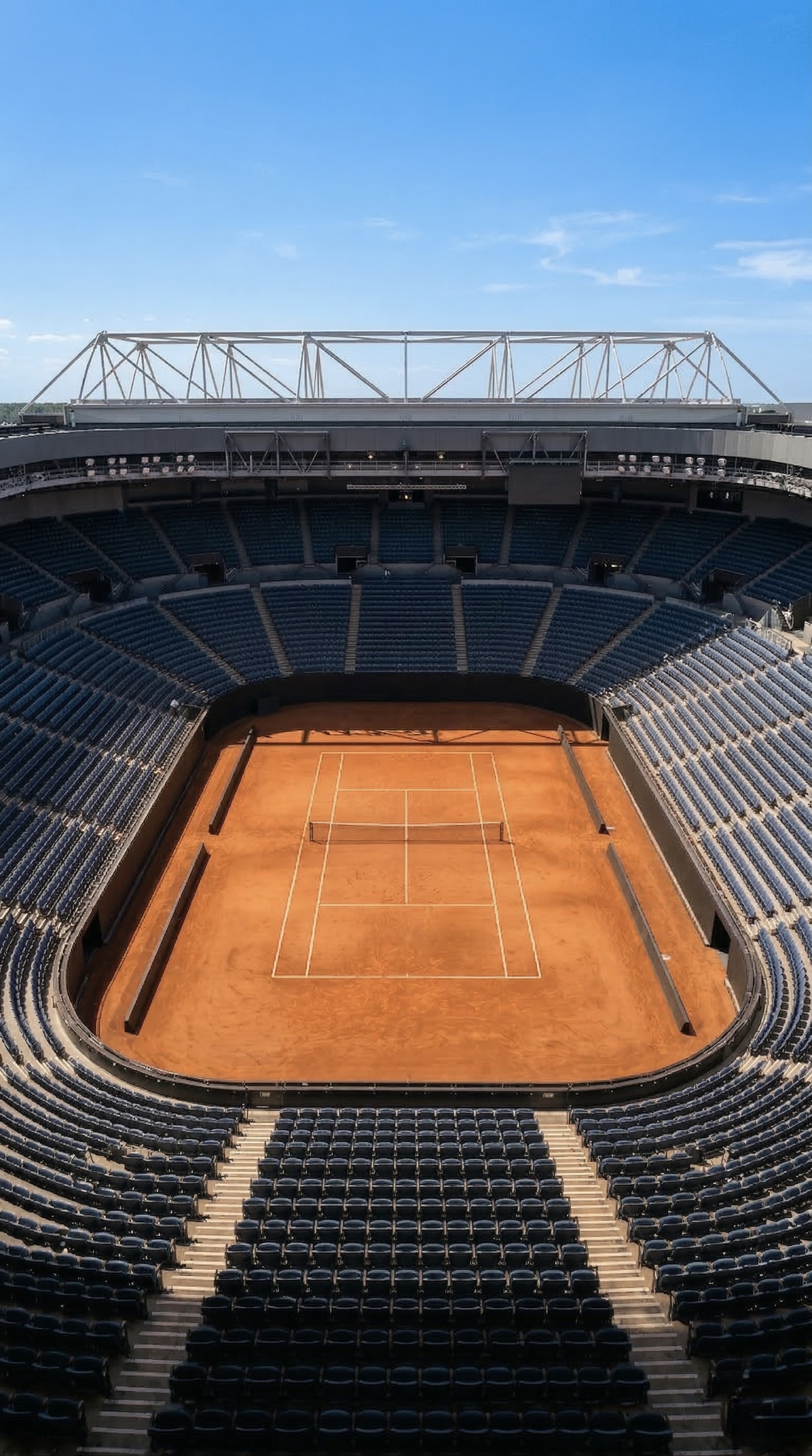
What happened next elevated her from promising talent to historic figure. At the Paris Olympics, playing on the same Roland-Garros clay where Li Na had won in 2011, Zheng produced the tournament of her life. She dispatched Sara Errani, Arantxa Rus, and Emma Navarro before meeting Angelique Kerber. Then came the quarterfinal that rewrote the script: Iga Swiatek, the world number one and undisputed queen of Parisian clay, fell to the Chinese twenty-one-year-old in a match that sent shockwaves through the sport. Zheng completed the run by defeating Donna Vekic of Croatia in the gold medal match. In China, millions watched live. The celebrations echoed the fervor that had greeted Li Na's triumphs a decade earlier.
The rest of 2024 confirmed that the Olympic gold was no one-off peak. Zheng won three more WTA titles, including the Pan Pacific Open in Tokyo and a second consecutive crown in Palermo. She reached the final of the WTA Finals in Riyadh, falling to Coco Gauff. She finished the year ranked fifth in the world, with a 2024 record that placed her among the three best players on tour. The WTA recognized her as the third-best player of the year.
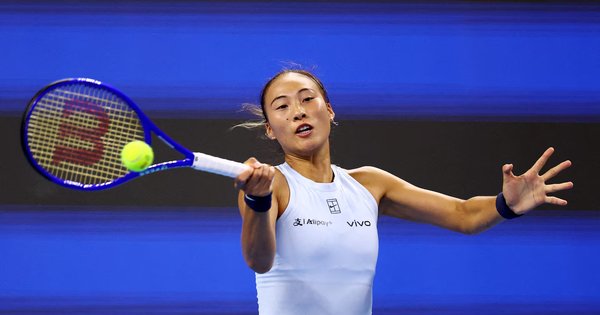
Physically, Zheng is built for the modern power game. She stands five feet ten inches tall and weighs around 154 pounds, an athletic frame that generates serious pace off both wings. Her forehand is the centerpiece of her game. Match Charting Data shows that she hits more winners, induces more forced errors, and commits fewer unforced errors with her forehand than the tour average, placing her in the top ten among active players for forehand effectiveness. The shot is struck with full weight transfer and a long follow-through that produces ball speeds capable of pinning opponents deep behind the baseline.
The backhand underwent a remarkable transformation in 2024. Data indicates that the shot became five times more effective over the course of the season, a development that expanded her tactical range dramatically. Working with coach Pere Riba, the former Spanish professional who has been in her corner since 2021, Zheng turned what had been a neutral wing into a genuine weapon. She can now hurt opponents from both sides, which makes her baseline game significantly harder to solve.
Riba's influence on Zheng's development deserves attention. The Barcelonan, whose own playing career was cut short by injuries and a car accident, brings the perspective of someone who has lived the pressures of professional competition. Their partnership, briefly interrupted before resuming at the end of 2023, has produced the most spectacular results of Zheng's career. Riba understands what it takes to beat the best players in the world because he competed against their equivalents on the men's tour.
The serve remains a work in progress. Zheng has the physical tools to deliver a formidable first serve, but consistency and placement are still being refined. This is the area of her game with the most room for improvement, and once it clicks, the complete package becomes genuinely frightening. Her footwork, exceptional for a player of her height, allows her to cover the court with an ease that surprises opponents accustomed to tall players lacking lateral mobility.
Aggression defines her tennis identity. Zheng plays to advance, to take time away from the opponent, to impose her rhythm from the first ball of the rally. On hard courts, her preferred surface, this approach is devastating. But one of the most encouraging developments in her recent game is her growing adaptability. The Olympic gold came on clay. In 2025, she reached the semifinals at Queen's Club, a grass court event where she had never previously gone beyond the early rounds, and that result pushed her to a career-high ranking of world number four in June.
The 2025 season, however, illustrated the growing pains that accompany a rapid rise. The year started poorly. A second-round loss to Laura Siegemund at the Australian Open and a first-round exit in Dubai to Peyton Stearns were the kind of results that test a young player's resolve. Zheng answered at Indian Wells, stringing together convincing wins over Victoria Azarenka, Lulu Sun, and Marta Kostyuk before losing to Swiatek in the quarterfinals. Semifinals in Rome and London and a quarterfinal at Roland-Garros followed, showing consistency across surfaces. Then an elbow injury struck in July, requiring surgery and cutting short a season that had been building real momentum.
The injury is a reminder of the physical toll that Zheng's aggressive style exacts. A game built on powerful ball-striking places enormous stress on the arm and shoulder. Managing that workload over a full season and a career spanning decades is one of the great challenges she faces. But she is twenty-three years old, and time is on her side.
The cultural weight Zheng carries extends far beyond her individual results. She is the torchbearer for Chinese tennis in the post-Li Na era, the player who proves that Li's impact was not an isolated chapter but the opening of a much longer story. The proliferation of WTA and ITF events in China, the construction of world-class training facilities, the emergence of young Chinese players on the professional circuit, all of this traces back to Li Na's breakthrough. Zheng is the most visible product of that legacy, and her Olympic gold represents a moment that may ultimately prove even more significant than Li's Grand Slam titles in terms of inspiring the next generation.
The numbers tell a compelling story: five WTA titles, a Grand Slam final, an Olympic gold medal, a career-high ranking of world number four, all achieved before her twenty-third birthday. But numbers only capture part of what makes Zheng Qinwen compelling. Watch her play and you see something that statistics cannot measure: a ferocity of intent, a willingness to go after every ball, a refusal to play safe that makes her one of the most exciting players on tour.
The first Grand Slam title feels like a matter of when, not if. She has already proven she can reach a major final. She has already beaten the world number one in a best-of-three Olympic format. The physical game is there. The mental toughness, forged through an Olympic gold medal campaign and a WTA Finals run, is there. The tactical range, expanded by the backhand improvement and growing surface versatility, is there. What remains is putting all of it together over seven matches and two weeks at the same Grand Slam tournament.
For those who watched Li Na captivate China and the tennis world a decade ago, watching Zheng Qinwen feels like seeing the next chapter unfold in real time. The girl from Shiyan who watched Li Na on television at age eleven is now writing her own history, with an Olympic gold medal as her opening statement. The story is far from over. Given what she has already accomplished, the chapters ahead should be remarkable.