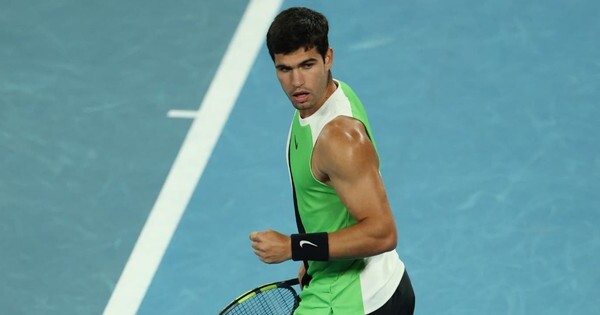
The grass of Church Road delivered its verdict on Sunday, July 13, 2025, and that verdict carries a name no one had previously associated with the conquest of tennis's most prestigious championship: Jannik Sinner, the first Italian in history to lift the Gentlemen's Singles trophy at Wimbledon. By defeating Carlos Alcaraz 4-6, 6-4, 6-4, 6-4 in the final, the world No. 1 ended the Spaniard's dream of a historic three-peat and claimed his fourth Grand Slam title in a career that now approaches the highest echelon of the modern era.
This 2025 edition will be remembered for far more than the final. A bloodbath in the opening rounds decimated the seedings with unprecedented brutality, sending shock waves through the draw and elevating unexpected contenders into the second week. Novak Djokovic reached a record-breaking fourteenth semifinal before falling to Sinner's quiet power. And the Sinner-Alcaraz rivalry, which now defines the architecture of men's tennis, gained a decisive new chapter on the very surface where it had always seemed to tilt toward the Spaniard.
The First-Round Carnage
Before the real stakes of the tournament took shape, 2025 produced a spectacle of devastation among the favorites that the All England Club had never witnessed at this scale. Thirteen men's seeds were eliminated in the first round, an all-time tournament record that tied the overall Grand Slam mark set at the 2004 Australian Open. Across both draws, twenty-three of the sixty-four seeded players exited after their opening match.
The names that fell were staggering. , the world No. 3 and third seed, was toppled by Frenchman Arthur Rinderknech in a four-hour, forty-four-minute battle that ended 7-6(3), 6-7(8), 6-3, 6-7(5), 6-4. The match was suspended Monday night at one set apiece due to the 11 p.m. curfew, and when play resumed Tuesday under the Centre Court roof, Rinderknech came out firing. Zverev failed to convert a single break point across nine opportunities, and afterward admitted he had never felt so empty.
, the ninth seed, met a similar fate against another Frenchman, Benjamin Bonzi, falling 7-6(2), 3-6, 7-6(3), 6-2. It was Medvedev's third consecutive first-round Grand Slam exit in 2025, a spiral that was deeply concerning for a player who had reached the previous two semifinals.
, the seventh seed and a 2024 semifinalist, was dispatched by Georgian veteran Nikoloz Basilashvili, ranked 126th in the world and winless in Grand Slam main draws for three years. The 6-2, 4-6, 7-5, 6-1 scoreline reflected Basilashvili's aggressive dominance in bursts, exploiting Musetti's lack of grass-court preparation following a leg injury sustained at Roland Garros.
For the first time since 2013, two top-five players were eliminated before the third round. The shockwave redrew the entire scene of the draw and opened pathways that would have been unthinkable forty-eight hours earlier.
Draper: The British Dream Shattered by Cilic
Jack Draper carried the weight of British expectation on his shoulders. Seeded fourth and playing before his home crowd, the twenty-three-year-old left-hander was meant to represent the next chapter of British tennis at SW19. His tournament ended in the second round, cut short by the experience and power of Marin Cilic.
The Croatian, a former US Open champion and finalist, had plummeted beyond the 1,000th ranking barely a year earlier. His resurgence was sudden and his 6-4, 6-3, 1-6, 6-4 victory over Draper stood as one of the first week's defining results. Cilic struck sixteen aces and fifty-three winners, imposing a brand of aggression that Draper simply could not counter. After the match, Draper conceded that Cilic had bullied him physically in a way that few opponents manage, underscoring the ongoing difficulty of his grass-court adaptation despite his status as the home favorite.
Alcaraz: A Turbulent Path to the Final
While the draw opened dramatically around him, had to navigate his own turbulence before reaching the final for the third consecutive year. His opening match against Fabio Fognini, in what amounted to the flamboyant Italian's farewell appearance at the All England Club, became a five-set ordeal: 7-5, 6-7(5), 7-5, 2-6, 6-1. Four hours and thirty-seven minutes of tennis played in a record-breaking opening-day temperature of 32.3 degrees Celsius.
The path smoothed out from there. Oliver Tarvet, a British qualifier from American college tennis ranked 733rd in the world, offered only token resistance in the second round at 6-1, 6-4, 6-4. Jan-Lennard Struff fell in four sets in the third round, 6-1, 3-6, 6-3, 6-4. It was in the fourth round against Andrey Rublev that the defending champion found his highest gear. After dropping the first set in a tiebreak, Alcaraz produced attacking tennis of the highest quality to win 6-7(5), 6-3, 6-4, 6-4 in two hours and forty-three minutes, firing forty-one winners to Rublev's twenty-nine.
The quarterfinal against Cameron Norrie was a demolition job. The Briton, buoyed by home support, lasted just ninety-nine minutes as Alcaraz swept through 6-2, 6-3, 6-3. The semifinal against offered a tighter script. The American, contesting his first semifinal and the first American man at that stage since John Isner in 2018, snatched the second set before yielding in a tense fourth-set tiebreak: 6-4, 5-7, 6-3, 7-6(6). Alcaraz had reached his third straight SW19 final, extending his winning streak at the tournament to eighteen matches.
Sinner: The Inexorable March to Glory
In the top half, initially appeared to be playing a different tournament entirely, so complete was his early-round dominance. Against compatriot Luca Nardi in the first round (6-4, 6-3, 6-0), Australian Aleksandar Vukic in the second (6-1, 6-1, 6-3), and Spaniard Pedro Martinez in the third (6-1, 6-3, 6-1), Sinner conceded just seventeen games across three matches. He did not lose his serve once in those three matches, the fewest games conceded by a No. 1 seed to reach the second week at since the Open Era began in 1968.
The fourth round nearly derailed everything. Against nineteenth seed Grigor Dimitrov, Sinner found himself down two sets to love at 3-6, 5-7 before the Bulgarian was forced to retire at 2-2 in the third set with a right pectoral injury. Dimitrov left the court in tears, assisted by Sinner himself in a scene that moved the entire stadium. It was the fifth consecutive Grand Slam retirement for Dimitrov, a painful pattern for a player whose talent has never been questioned.
In the quarterfinals, Sinner regained his best form to dispatch Ben Shelton 7-6(2), 6-4, 6-4, controlling the match from start to finish despite the American's firepower. And it was in the semifinals that the world No. 1 delivered what may stand as his most complete performance of the tournament.
Djokovic: One Hundred Wins and a Last Stand
moved through 2025 with the majesty of a king whose reign is ending but whose authority within his castle walls remains intact. His run was punctuated by historic milestones, beginning with his hundredth main-draw victory at , achieved in the third round against Miomir Kecmanovic with a 6-3, 6-0, 6-4 scoreline. In the fourth round, he overcame the loss of the opening set to Alex de Minaur to win 1-6, 6-4, 6-4, 6-4. In the quarterfinals, he again recovered from a set down against the surprising Flavio Cobolli, prevailing 6-7(6), 6-2, 7-5, 6-.
By reaching the semifinals for the fourteenth time at , Djokovic surpassed Roger Federer to set a new men's record. But it was precisely at that stage that the mountain proved too steep. Against Sinner, the Serbian fought bravely but insufficiently. The 6-3, 6-3, 6-4 scoreline in the Italian's favor reflected clear-cut domination.
Sinner neutralized Djokovic's serve with surgical efficiency on return, breaking the rhythm that the Serbian typically imposes on grass. The Italian's ball-striking power, combined with an unusual precision on this surface, left no margin for a Djokovic who, at thirty-eight years old, simply no longer possesses the physical resources to contain a player of this caliber across three consecutive sets. The pursuit of an eighth title, the one that would have separated him from Federer in 's history, must wait, if it ever materializes at all.
The Final: Sinner Overturns Alcaraz and Enters History
On Sunday, July 13, Centre Court hosted the second consecutive final between the two best players in the world. Alcaraz, undefeated in his five previous Grand Slam finals, held the psychological advantage of a player who had never tasted defeat in such circumstances. Sinner, for his part, had never beaten Alcaraz at and sought to break a spell that had made London's grass seem like the Spaniard's exclusive territory.
The first set appeared to confirm the established hierarchy on this surface. Alcaraz, aggressive and precise, took control of the rallies to claim it 6-4. But from the second set onward, Sinner underwent a remarkable transformation. His first-serve percentage, which sat at 62% compared to just 53% for Alcaraz, allowed him to seize the initiative in service games. The Italian gradually suffocated his opponent, imposing a baseline tempo that even Alcaraz, normally so comfortable in rapid grass-court exchanges, could not counter.
Three consecutive sets won 6-4, with a metronomic consistency that may be the most distinctive hallmark of Sinner's game. Forty winners for the Italian against thirty-eight for the Spaniard, but above all a mastery of the crucial moments that made the difference. Alcaraz, hampered by an uncharacteristically low first-serve percentage and seven double faults, never recaptured the fluidity that had defined his two previous SW19 finals.
On match point, Sinner dropped to his knees on the grass he had just conquered for the first time. First Italian in history to win , fourth Grand Slam title at just twenty-three years old, and the first player since at the 2011 Australian Open to eliminate both finalists from the previous edition in the same tournament. Sinner's 2025 record, with the Australian Open, Roland Garros, and now , traces the trajectory of a player no longer content to dominate the rankings but determined to leave an indelible mark on the history of the sport.
Fritz: The American Breakthrough
In the wake of the favorites, delivered the best result of his career by reaching the semifinals. The American, ranked fifth in the world, navigated a draw made chaotic by the early eliminations with impressive composure. His quarterfinal victory over Karen Khachanov, 6-3, 6-4, 1-6, 7-6(4), where he weathered a fierce third-set fightback from the Russian before closing in a tense fourth-set tiebreak, demonstrated the new maturity of his grass-court game. Fritz became the first American man in a semifinal since John Isner in 2018, ending a drought that had weighed on American men's tennis at the home of grass-court tennis.
The Lessons of a Historic Edition
2025 confirmed in emphatic fashion that men's tennis now operates under the joint reign of and . The two men reached their second consecutive Grand Slam final against each other, and their rivalry now structures every major appointment on the calendar with an intensity the sport had not known since the finest hours of the Federer-Nadal era.
Sinner proved that his dominance knows no surface limitation. Winner of three of the four Grand Slams in 2025, only the US Open stands between him and a calendar-year Grand Slam that would be the first since Rod Laver in 1969. The idea, unthinkable a year ago, is beginning to acquire a startling solidity given the Italian's upward trajectory.
Alcaraz, despite the defeat, remains a champion of rare quality whose eighteen-match winning streak, broken only in the final, testifies to an uncommon affinity with grass. His three-peat was not to be, but at twenty-two years old, he has all the seasons in the world to return and engrave his name even deeper into SW19's history.
Djokovic may have fought his last major campaign at as a genuine title contender. His hundredth victory and fourteenth semifinal will endure in the record books, but the gap that opened against Sinner suggests that the Serbian era at SW19, if not yet concluded, is approaching its natural end.
As for the first-round carnage, it raises broader questions about the state of professional tennis in 2025. The depth of the tour has never been greater, and players ranked beyond the top 50 now possess the physical and technical means to trouble anyone on a surface as distinctive as grass. 2025 served as a thunderous reminder that in tennis, the ranking hierarchy is merely a suggestion that the court reserves the right to overrule.