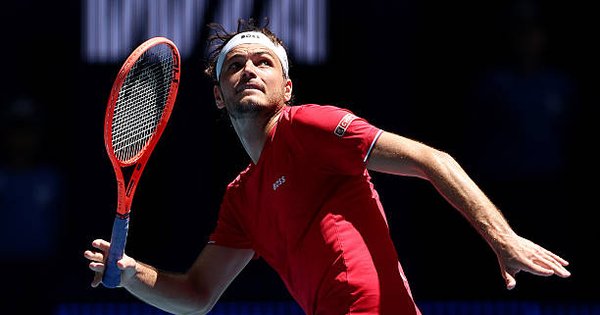
There is a weight in American tennis that no single player asked to carry, yet it has been passed down for over two decades like an unwanted inheritance. Since Andy Roddick lifted the US Open trophy in 2003, no American man has won a Grand Slam singles title. The country that produced Pete Sampras, Andre Agassi, and John McEnroe has spent twenty-two years searching for its next champion. At twenty-seven years old, Taylor Fritz has emerged as the most compelling answer to that search, a conclusion that crystallized under the lights of Arthur Ashe Stadium on a September evening in 2024.
Born on October 28, 1997, in Rancho Santa Fe, an affluent community in San Diego County, California, Taylor Harry Fritz entered a world where tennis was not merely a pastime but a family tradition. His mother, Kathy May, was a professional player on the WTA tour during the late 1970s and 1980s, reaching as high as the top ten in the world rankings. His father, Guy Fritz, a respected tennis coach, shaped his son's earliest strokes on the sun-drenched courts of Southern California. The young Taylor never knew a life without a racket in hand, without the relentless pursuit of the perfect shot that defines tennis families.
This early immersion produced a player of remarkable technical maturity. By his teenage years, Fritz had developed a devastating forehand, struck flat with controlled violence that recalled the great American power players of previous generations. His serve, regularly clocked above 135 miles per hour, became a formidable weapon that allowed him to compete with the best in pressure moments. Standing six feet four inches tall, he possessed the wingspan and athletic power to dominate from the baseline.
The transition to professional tennis came in 2015, when Fritz was just seventeen. He wasted no time making an impression. In 2016, he won his first ATP title in Memphis, becoming the youngest American to claim an ATP trophy since Andy Roddick in 2001. That early title immediately fueled comparisons and expectations. The American tennis media, perpetually hungry for a successor to its legends, began projecting outsized hopes onto this kid from California.
But the path to the summit of world tennis is rarely linear, and Fritz would learn that lesson through years of grinding work. The seasons following his first title were marked by steady but sometimes frustrating progress. He established himself in the top fifty, then the top thirty, collecting encouraging victories without ever producing the major breakthrough everyone anticipated. Grand Slam defeats accumulated, often in the early rounds, feeding doubts about his ability to perform when the stakes were highest.
This period of maturation, ungrateful as it felt at the time, forged a more complete competitor. Fritz worked tirelessly on the most fragile elements of his game. His backhand, long considered the weakest link in his arsenal, gained consistency and aggression. His net game, initially rudimentary for a player of his stature, gradually improved. Most importantly, he developed a mental resilience that transformed his approach to the biggest occasions on tour.
The year 2022 marked a significant turning point. Fritz won the prestigious Indian Wells tournament, one of the most important events on the circuit outside the Grand Slams. In the final, he overcame Rafael Nadal in a match that would be etched into the memory of American tennis. Defeating the Bull of Manacor in such a setting, before a crowd completely devoted to his cause, represented far more than a simple sporting victory. It was a statement of intent, proof that Fritz possessed the quality required for the grandest stages.
That triumph sparked a sustained climb in the world rankings. Fritz established himself firmly in the top ten, reaching a ranking that no American man had held with such consistency in years. He became the undisputed standard-bearer of American men's tennis, a status that brought equal measures of pride and pressure. Every Grand Slam appearance was now scrutinized with particular intensity, every loss dissected as a collective failure.
Then came the evening of September 8, 2024, and the US Open final. became the first American man to contest the singles final at his home Grand Slam since Andy Roddick in 2006. Eighteen years of waiting for a country that counts tennis among its major sports. The opponent was Jannik Sinner, the Italian prodigy who had burst onto the global stage that same year by winning the Australian Open. The context was simultaneously magical and crushing.
The match told the story of a Fritz who refused to surrender despite the weight of the moment. Against Sinner, whose baseline consistency and power had become the best on tour, the American fought with remarkable intensity. His forehand thundered through the stadium, his serve kept him in contention, the Ashe Stadium crowd roared at every point won. But Sinner was merciless. The Italian prevailed in straight sets, with the clinical composure that had become his trademark.
The defeat was painful, but the journey was historic. Fritz had shown the world that an American could still compete at the highest level in Grand Slam tennis. The tears he struggled to contain during the trophy ceremony spoke to the colossal emotional investment that accompanied his every performance. He was not playing only for himself. He carried the dreams of a tennis nation desperate for renewal.
The conclusion of the 2024 season confirmed his place among the world's elite. Fritz competed at the ATP Finals in Turin, the season-ending championship reserved for the top eight players, and delivered solid performances. His year-end ranking placed him among the top five or six players in the world, a position that had seemed unreachable just a few years earlier. The balance sheet of his 2024 campaign was impressive: multiple ATP titles, a Grand Slam final, and a consistency at the highest level that testified to a newly acquired maturity.
The start of the 2025 season served as a reminder that high-level tennis tolerates no complacency. At the Australian Open in January, Fritz was eliminated in an early upset by Gael Monfils, the French veteran who, at thirty-eight years old, continues to defy the laws of time and athletic decline. The loss, surprising as it was, illustrated the volatility of professional tennis and the difficulty of maintaining excellence over sustained periods. It also underscored that Fritz, despite his considerable progress, remains vulnerable against opponents capable of elevating their game in individual matches.
That premature exit in Melbourne raised legitimate questions about managing the pressure that accompanies his elevated status. After a Grand Slam final, expectations increase mechanically, and every underperformance is amplified by media and public scrutiny. Fritz must now learn to navigate these turbulent waters, to manage the hopes of an entire country without being overwhelmed by the burden of responsibility.
From a technical standpoint, Fritz possesses undeniable assets to continue his upward trajectory. His forehand remains one of the most dangerous weapons on tour, capable of destabilizing any opponent from any position on the court. His serve, when firing at full capacity, generates a considerable number of free points that relieve the pressure during service games and allow him to play more freely in return games. His physical conditioning, maintained with exemplary discipline, enables him to sustain five-set matches with the endurance required at the Grand Slam level.
Questions persist, however, about certain elements of his game. His backhand, though improved significantly, remains less reliable than those wielded by the very best players in the world. Against opponents like Sinner or Carlos Alcaraz, who excel at targeting an adversary's weaknesses with surgical precision, this technical imbalance can prove costly in decisive moments. His ability to vary his game, to step outside his comfort zone by adopting different tactical patterns, remains a work in progress.
The comparison with the giants he must dethrone is both motivating and daunting. Novak Djokovic, even approaching his thirty-eighth birthday, continues to represent a nearly insurmountable mountain in Grand Slam competition. Sinner and Alcaraz, both younger than Fritz, appear to have seized the initiative in the race for global supremacy. For the American, the window of opportunity exists but it is not infinite. At twenty-seven, he is entering what should be the peak years of his career, and the next two or three seasons will be decisive.
Beyond the titles and rankings, Fritz represents something deeper for American tennis. He represents the hope that after years of European dominance, a player forged on the hard courts of California can once again conquer the world. His journey, built on doubts overcome and patient progress, tells a universal story of perseverance and ambition that resonates far beyond the sport itself.
Whether or not ultimately lifts a major trophy, he will have marked his era as the player who dared to believe that America could once again become a land of men's tennis champions. His destiny remains unwritten. The 2025 clay court season and the grass court swing will offer new opportunities to shine, new examinations against the world's elite. What is certain is that every time he steps onto a show court, millions of Americans will hold their breath, quietly hoping that this will be the day their champion finally delivers the breakthrough an entire generation has been waiting for. The burden is immense, but Fritz has proven he has the shoulders to bear it.