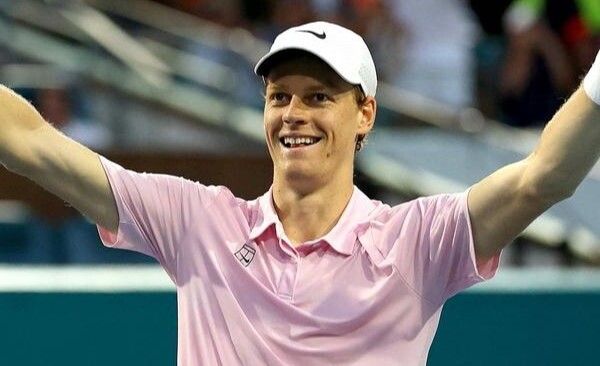
There are weeks in tennis when the sport bends toward a single figure, when the tournament bracket functions less as a competitive structure and more as a formality. The final week of October 2025 at the Accor Arena in Paris belonged entirely to Jannik Sinner. The Italian dismantled Felix Auger-Aliassime 6-4, 7-6(4) in the final to claim his maiden Rolex Paris Masters title, completing a run through the draw without dropping a set. The victory carried an additional prize: the world No. 1 ranking, reclaimed from Carlos Alcaraz in the tightest title race the men's game has produced in years.
This was Sinner's fifth Masters 1000 crown and his fifth title of the 2025 season. He had never previously advanced past the third round in Paris. In the space of five matches and twenty-nine conceded games, the fewest since the event moved to hard courts in 2007, he turned a career-long blind spot into a personal showcase.
Building Through the Draw
Sinner opened against Zizou Bergs, a Belgian ranked 41st who had knocked out Alex Michelsen in the previous round. The 6-4, 6-2 scoreline was comfortable enough, though Bergs made Sinner work through a competitive first set before the Italian's baseline depth gradually suffocated the rallies. It set the template for the week: Sinner started each match with a period of calibration, reading his opponent's patterns, then systematically dismantled them.
Francisco Cerundolo provided a sterner examination in the third round. The Argentine, whose baseline tenacity translates effectively to indoor hard courts, held firm through a tight first set before succumbing 7-5, 6-1. That opening set represented Sinner's most uncomfortable stretch of the tournament. Cerundolo refused to miss, dragging rallies deep and forcing Sinner to manufacture winners rather than wait for errors. Once the dam broke, the second set was academic.
The quarterfinal against Ben Shelton carried the most dangerous potential in the draw. The fifth-seeded American, fresh from eliminating Andrey Rublev, owns one of the tour's most devastating serves. On fast indoor courts, that weapon can hijack any match in a handful of games. Sinner's response was definitive: 6-3, 6-3 in eighty minutes. He neutralized Shelton's serve by returning with exceptional depth, pushing the American onto his second delivery, then punishing those slower balls without mercy. The quality of Sinner's return game that evening will rank among the highlights of his season.
The Zverev Demolition
Then came the semifinal against , the defending champion and world No. 3. What unfolded on the Accor Arena's main court on Saturday, November 1, 2025, will be discussed for years. Final score: 6-0, 6-1. Sixty minutes of play. A sporting humiliation inflicted upon one of the world's best players on a surface where the German typically thrives.
Zverev had scraped into the semifinals by saving two match points against Daniil Medvedev in the previous round, prevailing 2-6, 6-3, 7-6(5) in a draining three-setter. He arrived on court visibly spent. Sinner was fresh, sharp, ruthless. Every ball from the Italian seemed calibrated with algorithmic precision. His forehand inflicted damage, his backhand found the lines, his serve offered no openings. Zverev never entered the match. The German sprayed errors, overwhelmed by the pace and quality coming from the other end.
That 6-0, 6-1 was not a fluke. It was the purest expression of what Sinner has become on indoor hard courts: a player whose consistency reaches levels that recall the greatest stretches of dominance in modern tennis. His indoor winning streak stood at twenty-six consecutive matches, a statistic that frames his current run in historical terms.
The Final: Auger-Aliassime's Breakthrough Week
Across the net in the final stood an unexpected but entirely legitimate opponent. Felix Auger-Aliassime, the ninth seed, had produced the most complete week of his career to reach the championship match. The twenty-five-year-old Canadian navigated the draw with a solidity that impressed the most demanding observers.
His path deserves examination. After convincing early rounds, Auger-Aliassime dispatched Valentin Vacherot 6-2, 6-2 in the quarterfinals before producing his best tennis of the week against Alexander Bublik in the semifinals. The Kazakh, seeded thirteenth and possessing a game as flamboyant as it is unpredictable, pushed the Canadian hard through a first set that contained no break points, settled 7-6(3) in Auger-Aliassime's favor. The second set delivered chaos: five breaks of serve, Bublik surging to a 4-1 lead, then Auger-Aliassime reeling off five consecutive games to close 6-4. That ability to reverse momentum under pressure spoke to a maturity the Canadian has built over seasons of learning.
The Paris result launched Auger-Aliassime into the world's top eight and secured his qualification for the Nitto ATP Finals in Turin, replacing in the final available slot. A fitting reward for a player whose development had occasionally appeared to stall after a blistering start to his professional career.
The final itself confirmed the prevailing hierarchy. Sinner seized control of the rallies from the opening games, imposing his ball depth and baseline consistency. The first set, decided 6-4, hinged on a single break of serve that Sinner manufactured with the patience of a player who knew time was on his side. Auger-Aliassime competed with distinction, producing sequences of high-quality tennis, particularly on serve, where he repeatedly tested Sinner's resolve. But the difference materialized in the decisive moments, those 30-30 points and break-point opportunities where Sinner consistently found the right shot.
The second set was tighter still. Auger-Aliassime elevated his game, refusing to concede an inch. The Canadian forced a tiebreak, where Sinner's experience and mental steel proved decisive at 7-4. On championship point, a clean service winner from the Italian sent the Accor Arena into euphoria. The perfect conclusion to a perfect week.
Alcaraz's Early Exit and Its Consequences
The other defining storyline of this Paris edition was Alcaraz's second-round elimination. The world No. 1 and top seed fell to Cameron Norrie 4-6, 6-3, 6-4, a result that qualified as the upset of the week. Norrie, who had clawed his way back up the rankings after an injury-plagued 2024 season, produced the performance of his career against the tournament favorite.
Alcaraz committed fifty-four unforced errors across nearly two and a half hours, numbers that reflected a level of play far below his usual standard. The Spaniard admitted afterward that he could not explain what had happened, citing timing and positioning issues that prevented him from establishing his customary offensive patterns. The loss ended his seventeen-match winning streak at Masters 1000 events, stretching back to Miami in March.
That early exit opened a window of opportunity that Sinner exploited with characteristic efficiency. The Italian knew that only the title would return him to the No. 1 ranking, and he fulfilled that objective without a moment of hesitation. After Paris, Sinner stood at 11,500 ATP ranking points against Alcaraz's 11,250, a narrow gap carrying enormous symbolic weight.
The Indoor Season in Context
This Paris title capped an indoor season that positions Sinner among the finest fast-court specialists in recent tennis history. Vienna, Beijing, and now Paris: the Italian transformed the closing stretch of the calendar into a personal hunting ground, accumulating victories with a regularity that evokes Djokovic's greatest indoor stretches.
His ability to sustain such an elevated level week after week rests on impeccable technical fundamentals and exceptional physical conditioning. His serve, long considered a relative weakness, has developed into a genuine weapon. His backhand, struck flat with controlled violence, is arguably the most consistent and effective on tour. And his return of serve, his true calling card, continues to dismantle the biggest servers in the game.
The 2025 Paris Masters will be remembered as the week Sinner proved he needed no dramatic narrative arc, no five-set epic, no match points saved. Just the methodical perfection of a champion who turned five matches into five tennis lessons. The draw cleared a path, and Sinner walked through it as though no other outcome had ever been possible.