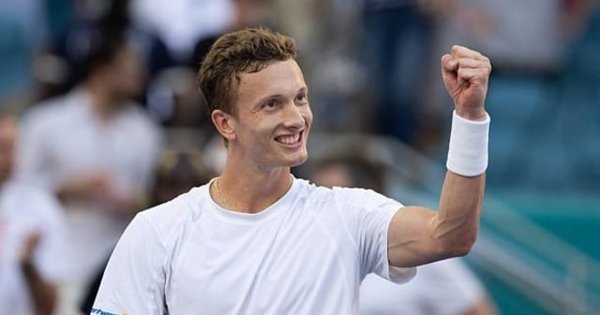
The future of men's tennis doesn't announce itself with a single thunderclap. It arrives in waves, and the 2026 Sunshine Swing delivered two of the most convincing yet. Over the span of two weeks between Indian Wells and Miami, Jiri Lehecka and Arthur Fils stamped themselves on the sport's biggest regular-season stage. Lehecka reached his first Masters 1000 final. Fils made his first Masters 1000 semifinal. Born less than three years apart, they left no doubt that the next generation has more to offer than just Carlos Alcaraz and Jannik Sinner.
Lehecka, born November 8, 2001, in Mlada Boleslav, arrived in Miami with a growing collection of credentials. Titles in Adelaide in 2024 and Brisbane in 2025 had given him a taste of winning, but nothing at this level. The Czech has spoken openly about how far he's come since earlier breakthrough moments, including that memorable win over Rafael Nadal in Madrid. "I consider myself a completely different player," he said during the Miami fortnight, and the numbers backed him up in spectacular fashion.
Through five consecutive wins before the final, Lehecka did not drop a single service game. Read that again. Five matches, not one break conceded. In three of those matches he saved a combined nine break points; in the other two, his opponents didn't even earn one. His serve became a fortress, and his baseline game turned into a wrecking ball that left bodies scattered across the draw.
The quarterfinal against qualifier Martin Landaluce was his tightest test, a 7-6(1), 7-5 affair that stretched past two hours. But even under pressure, Lehecka found the gears he needed. The tiebreak was clinical, and the second set showed the kind of composed aggression that separates contenders from pretenders.
Then came the semifinal against Fils, and it was a demolition job. Lehecka blitzed the Frenchman 6-2, 6-2 in just 75 minutes, playing with an intensity that left almost nothing for his opponent to work with. Every rally felt like it was on Lehecka's terms. The ball came off his racket heavier, deeper, more consistently than anything Fils could handle.
The final against Sinner told a different story. Lehecka lost 4-6, 4-6 to the world number one, who simply had too much quality on the day. But there was no shame in that scoreline, and Lehecka left Miami having climbed eight places to a career-high ranking of 14th. He became the eighth Czech player to reach a Masters 1000 final, continuing a proud tradition that includes the likes of Tomas Berdych and Petra Kvitova on the women's side.
If Lehecka's Sunshine Swing was a statement of steady, relentless progress, Fils's was something closer to resurrection.
Born June 12, 2004, the Frenchman had his 2025 season derailed by a stress fracture in his back, first detected around Roland-Garros. By August, his year was over. For a player still only 21 at the time, it was a brutal setback, the kind that can stall a career before it truly begins.
What Fils did next showed a maturity beyond his years. In February 2026, he entered a trial partnership with Goran Ivanisevic, the former Wimbledon champion who had spent years coaching Novak Djokovic at the summit of the sport. The Croatian brought not just tactical expertise but an understanding of what it takes to compete at the very highest level, week after week, month after month.
Fils overhauled more than his coaching setup. He gave up chocolate biscuits, reworked his lifestyle habits, and hired a traveling physiotherapist to keep his body in shape across the grind of the tour. These might sound like small details, but at the elite level, small details are the difference between a quarterfinal exit and a deep run.
The results came quickly. A quarterfinal in Montpellier. A final in Doha. Then Indian Wells, where he reached the quarterfinals with a run that included a 6-3, 7-6(9) demolition of Felix Auger-Aliassime in the fourth round before falling to Alexander Zverev.
Miami, though, was where everything clicked. In the third round, Fils produced what he later called "one of the best matches I've ever played," annihilating Stefanos Tsitsipas 6-0, 6-1 in 55 minutes. It was the kind of performance that makes the rest of the locker room sit up and pay attention. Fils was candid about what it meant to him. "Oh man, I'm fully back," he said afterward, grinning like a kid who'd just found his favorite toy under the couch.
The quarterfinal against Tommy Paul was a different beast entirely. Playing in front of an American crowd desperate to see their man advance, Fils found himself staring down four match points. He saved every single one. The mental fortitude required to pull that off, in that environment, against a player of Paul's quality, was remarkable for someone his age. It made him the youngest Frenchman to reach a Masters 1000 semifinal since Richard Gasquet managed it at 21 back in 2007.
The semifinal against Lehecka was a harsh landing. That 2-6, 2-6 loss exposed the gap that still exists between Fils and the very best on their strongest days. But context matters. His overall Sunshine Swing record, a quarterfinal at Indian Wells followed by a semifinal in Miami, was outstanding by any measure, and it pushed him up to 28th in the world rankings.
What makes these two particularly interesting is where they sit in the generational hierarchy. Alcaraz, born in 2003, and Sinner, born in 2001, have already established themselves as the sport's co-leaders. Lehecka and Fils represent the layer just behind them, the players who could turn the top of men's tennis from a duopoly into something more crowded and unpredictable.
Their games, though, are quite different. Lehecka is a baseline basher in the purest sense. His serve is a weapon, his forehand dictates play, and he builds points with the kind of relentless pressure that wears opponents down physically and mentally. There's a directness to his tennis that fits neatly into the Czech tradition, a lineage that runs through Berdych and values power channeled through discipline.
Fils is more varied, and that's what makes him so exciting. He has genuine power, but he also has touch. He can change rhythm mid-rally, find angles that other players don't see, and mix aggression with subtlety in ways that recall a younger Gael Monfils. At 21, he already owns three ATP titles, including a 500-level trophy from Hamburg in 2024 where he beat Zverev in the final. That kind of pedigree, combined with Ivanisevic's experience coaching at the absolute peak of the sport, suggests his ceiling is very high indeed.
The Ivanisevic partnership deserves particular attention. The Croatian knows exactly what a player needs to do to compete for Grand Slams. He watched Djokovic up close for years, understood the margins, the preparation, the mental framework required to win the biggest matches. If he can transmit even a fraction of that knowledge to Fils, the Frenchman could become a serious problem for everyone in the draw.
Looking ahead, the paths diverge slightly. Lehecka's target is clear: the top 10. At 14th, he's knocking on the door, and a strong clay season through Monte-Carlo, Madrid, Rome, and Roland-Garros could get him there. His game translates well to clay, where his heavy ball and strong serve still carry weight, and he's shown enough improvement in his movement to suggest he won't be easy to outmaneuver on the slower surface.
For Fils, the challenge is different. He needs to prove that the Sunshine Swing wasn't a post-injury spike, one of those bursts of form that sometimes follow a long layoff before reality sets in. The stress fracture that ended his 2025 season is the kind of injury that can linger, not physically but psychologically, creating doubt in moments where confidence is everything. Clay will be instructive. The surface demands more from the body, more sliding, more grinding, more physical resilience across long rallies and longer matches.
Both players showed in March that they have the raw ingredients to move from good to great. Lehecka's serve-and-forehand combination, paired with his improving consistency, gives him a clear pathway to the sport's elite. Fils's blend of power, variety, and competitive fire, now backed by a coaching setup that understands what greatness looks like, makes him one of the most intriguing young players on tour.
The Sunshine Swing has always been men's tennis at its most revealing. The conditions are fast, the draws are deep, and there's nowhere to hide over the course of two grueling weeks. Lehecka and Fils didn't just survive. They thrived. And the rest of the tour has been put on notice.