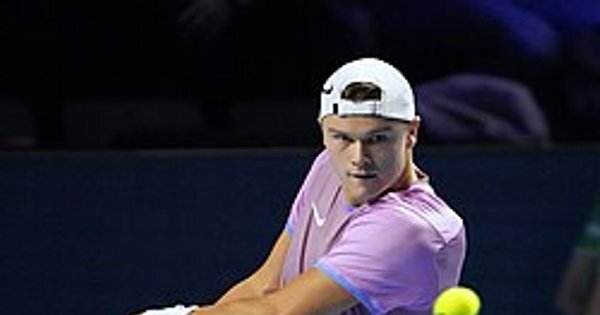
There is a particular kind of tennis player who announces himself before the evidence fully arrives. The talent is so visible, so blindingly obvious, that the coronation begins before the crowns have been earned. Holger Vitus Nødskov Rune has been living inside that narrative since he was a teenager. Born on April 29, 2003, in the Copenhagen suburb of Gentofte, the Dane won the Paris Masters at nineteen, reached world number four, and collected five ATP titles before his twenty-third birthday. On paper, this is the CV of a future Grand Slam champion. In practice, the story is considerably more complicated.
Rune came to tennis through his sister Alma. He followed her to the courts at six years old and never left. His first coach, Lars Christensen, laid the technical groundwork for a game built on aggression and early preparation. His mother, Aneke, assumed a role that went far beyond the stands. She became his manager, his emotional anchor, and by his own admission, his mental coach. That relationship, visible at every tournament, has drawn praise for its closeness and criticism for its intensity in roughly equal measure. Rune himself has been unapologetic about it: she knows him better than anyone, he says, and she tells him the truth even when he does not want to hear it.
The junior career was a demolition job. European under-14 champion in 2017. French Open boys' singles champion in 2019 at sixteen. Junior world number one by October of that same year after winning the ITF Junior Finals. Ten ITF junior titles in total. The scouts and talent evaluators who had watched thousands of promising teenagers come and go agreed on one thing: Rune possessed a rare cocktail of natural aggression, shot quality, and competitive ferocity that separated him from the annual crop of hopefuls who never make it.
The professional breakthrough came fast. In April 2022, Rune won his first ATP title in Munich, beating Alexander Zverev, the world number three, along the way. Stockholm followed in October, with a straight-sets demolition of Stefanos Tsitsipas in the final. But the week that changed everything was Paris in November 2022. Five victories over top-ten players in a single tournament, a feat unprecedented in ATP history outside the year-end Finals. Hubert Hurkacz, Andrey Rublev, Carlos Alcaraz, Felix Auger-Aliassime, and then Novak Djokovic in the final. At nineteen, Rune had accomplished what most players never achieve in an entire career.
The architect of that Parisian siege was Patrick Mouratoglou. The famous French coach, known for his work with Serena Williams, had taken Rune under his wing in October 2022. The results were immediate and spectacular. They also inaugurated what has become the most exhausting soap opera in recent men's tennis: Holger Rune's coaching carousel. Mouratoglou left after six months. Then returned. Then left again in September 2023. Then returned in February 2024, only to be replaced by Boris Becker. The German legend extended through 2024 before departing in August 2025. Mouratoglou came back yet again in July 2025. This relentless turnover, which would destabilize any player, points to a fundamental difficulty in Rune's makeup: an inability to build a lasting relationship of trust with an authority figure outside the family circle.
The 2023 season confirmed the enormous potential while exposing the limitations. A fourth title in Munich, Masters finals in Monte Carlo and Rome that pushed him to a career-high ranking of world number four. But quarterfinal exits at Roland-Garros and Wimbledon, despite their prestige, left a lingering sense of incompleteness. Rune appeared capable of beating anyone over a week but incapable of sustaining that level across two weeks at a Grand Slam. The gap between raw talent and top-level consistency became the central debate around his career.
His playing style mirrors his personality: aggressive, direct, uncompromising. Rune is a baseline attacker who imposes a high tempo from the first exchange. His two-handed backhand is considered one of the purest among the next generation, capable of producing devastating winners from any position on the court. His forehand, struck with a generous topspin that draws comparisons to Rafael Nadal, bounces high and keeps opponents permanently uncomfortable. His preparation is short and early, giving him a timing advantage over most rivals. His return game, often underestimated, is a formidable weapon that allows him to pressure opponents from the moment they serve. When everything clicks, when the mechanics are oiled and the mind follows, Rune produces tennis that places him among the five or six best players on the planet.
But there is the other Rune. The one who unravels on court when things do not go his way. The one who argues with umpires, seethes in his chair, gesticulates toward his box, and accumulates warnings for time violations and unsportsmanlike conduct. At the Monte Carlo Masters in 2024, a time violation at a critical moment against Jannik Sinner triggered an emotional spiral that ended with an additional penalty after he gestured at the crowd. At the Madrid Open, he accused the tournament of cheating after discovering missing strings on his racket. These incidents, repeated across seasons, earned him the unflattering nickname Holger Rude in tennis circles. Jim Courier publicly stated he needed to behave better. Other legends of the sport offered similar assessments.
The emotion question with Rune is more complex than it appears. You cannot ask a player to compete with the intensity that makes him dangerous and expect him to remain impassive when decisions feel unjust. The raw energy, the competitive rage that allows him to overturn impossible matches, is the same force that consumes him when circumstances turn. The greatest champions all had to learn to channel that inner fire. McEnroe screamed at umpires and still won Grand Slams. Djokovic spent years mastering his emotional demons before becoming the most dominant player in history. Rune, at twenty-two, is still in that learning phase.
The 2024 season was one of stagnation. No titles. A ranking that slipped outside the top ten. Inconsistent performances that fed the doubts. The repeated coaching changes, from Mouratoglou to Becker and back to Mouratoglou, projected the image of a player seeking external solutions to problems that were perhaps fundamentally internal. The ATP Tour is unforgiving with players who do not progress. While Rune spun his wheels, Jannik Sinner settled in at world number one and Carlos Alcaraz kept collecting Grand Slam trophies. The window of opportunity that seemed wide open after Paris 2022 was starting to close.
Then 2025 arrived, and with it encouraging signs of renewal. The first strong signal came at Indian Wells, where Rune reached his first Masters 1000 final since 2023, taking out Tsitsipas, Griekspoor, and Medvedev along the way. He became the first Dane and youngest Scandinavian to reach the Indian Wells final since Stefan Edberg in 1987. Barcelona in April was the turning point. Rune won his fifth ATP title there, and not just any title: a 7-6(6), 6-2 victory over Carlos Alcaraz in the final. Dominating the Spaniard on clay, practically on his home turf, with that kind of authority sent a clear message to the tour. Rune climbed back to world number nine, returning to a top ten he had been away from for too long.
The rest of 2025 sustained the positive momentum without fully erasing the doubts. A fourth round at Roland-Garros, stopped by Lorenzo Musetti. A fourth round at Wimbledon, ended by Novak Djokovic. Solid, respectable results that still did not bridge the gap between perceived potential and concrete Grand Slam achievement. The US Open, with a second-round exit, reminded everyone that consistency remained the primary construction site. His 36-22 season record showed a player who won far more than he lost but who could not yet convert that general competitiveness into exceptional performances when it mattered most.
The season's end took a devastating turn. In the Stockholm Open semifinals on October 18, 2025, Rune ruptured his left Achilles tendon against Ugo Humbert. A catastrophic injury, suffered on a court where he had lifted the trophy three years earlier. Rune himself admitted he had rushed his return after Shanghai, chaining competitions without giving his body time to recover. That impatience, that inability to ease off the accelerator, may be the most faithful reflection of his personality: a competitor who wants everything, immediately, even at the risk of paying a heavy price.
The recovery that followed has offered Rune something the relentless tour schedule never afforded him: time. Time to reflect on his career, his choices, and the direction he wants to take. By January 2026, he was learning to walk again after two months of immobilization. By February, he was back on court for light exercises, both feet planted on the ground. Each step of the rehabilitation represents a lesson in patience for a player who has never excelled at that particular discipline.
The comparison with his contemporaries is instructive. Sinner, born the same year, became world number one through methodical work and remarkable emotional stability. Alcaraz, one year older, stacks Grand Slam titles with infectious joy. Draper, Fils, Mensik, and the rest of their generation progress at different rates but with generally upward trajectories. Rune resembles an electrocardiogram: spectacular peaks followed by sharp drops, never finding the steady line that characterizes the great champions.
Yet reducing Rune to his excesses and inconsistencies would be deeply unfair. Behind the headlines and the controversies stands a twenty-two-year-old carrying the expectations of an entire country, a young man who grew up under the professional circuit's spotlight since adolescence, trying to find his balance in an environment where every mistake is amplified by social media and omnipresent cameras. The pressure on a prodigy is of a particular nature: he is not forgiven for being merely good. He is expected to be exceptional at all times.
The Achilles injury could paradoxically become the catalyst for a profound transformation. Tennis history is full of players who found a new dimension after a serious injury, forced to rebuild not only their bodies but also their approach to the game and competition. Rune possesses every ingredient to become a Grand Slam player. The question was never about talent. The question has always been about the head, the heart, and the ability to assemble every piece of the puzzle at the same time. The Danish prodigy is twenty-two, with a career ahead of him and an Achilles tendon to rebuild. The story is far from over.