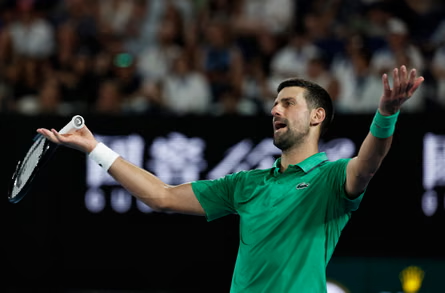
Novak Djokovic has never played so little before a Grand Slam. Three tournaments in 2026, one single match on clay this season, and yet the Serb arrives at Porte d'Auteuil with the unwavering ambition of claiming a 25th major title.
At 39, the three-time Roland Garros champion has deliberately chosen scarcity over saturation. Gone are the extended clay-court preparation blocks and the steady stream of warm-up events. Djokovic has prioritized physical recovery and targeted training, banking on the experience from his 24 Grand Slam titles to offset the lack of competitive rhythm.
The appointment of Viktor Troicki as coach, announced last week, reflects this strategic pivot. A former world No. 12 and long-time Davis Cup teammate, Troicki knows Djokovic's game inside out. This choice of familiarity, following stints with Goran Ivanisevic and Boris Becker, signals a preference for comfort and mutual understanding over tactical upheaval.
His first-round opponent is Giovanni Mpetshi Perricard, the big-serving Frenchman who can trouble any returner with his blistering ace count. It is an immediate test for a player who has barely competed in recent weeks.
The central question is straightforward: can Djokovic succeed where the schedule suggests he should not? His track record argues in his favor. In 2023, he lifted the Coupe des Mousquetaires under similar circumstances of doubt and underestimation. The Serb built his legend on defying pre-written narratives.
Carlos Alcaraz's absence with a wrist injury opens up the bottom half of the draw. World No. 1 Jannik Sinner, riding a 29-match winning streak, sits in the opposite half, meaning Djokovic avoids the favorite until a potential final.
Whether his body and timing will cooperate remains the open question. At Roland Garros, Djokovic has never needed many matches to find his level. But he has never arrived with so few reference points on the surface. The gamble of scarcity may be the latest invention in a career that continues to push the boundaries of what is possible.