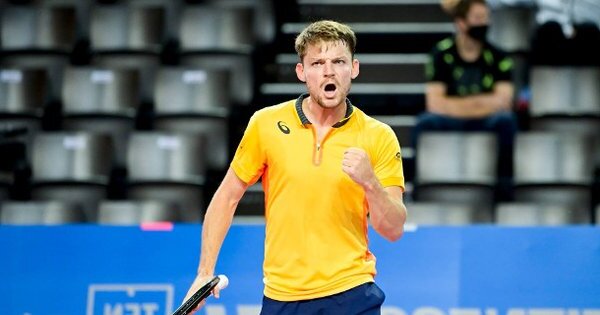
Some players dominate through brute force. They overpower opponents with a serve that cracks like thunder or a physique built for intimidation. David Goffin was never one of them. At 180 centimeters and 70 kilograms, the Belgian walked into locker rooms full of athletes who looked like they could snap him in half. For more than a decade, he beat them anyway. He did it with a backhand that belonged in a textbook, footwork that made bigger men look clumsy, and a tactical brain that turned every apparent physical disadvantage into a competitive edge. When Goffin announced in March 2026 that the current season would be his last, he closed the book on the greatest career in Belgian men's tennis history.
Goffin was born on December 7, 1990, in Rocourt, a suburb of Liege in the French-speaking part of Belgium. Tennis ran in the family. His father Michel coached professionally at the Barchon Club, his mother Francoise played recreationally, and his older brother Simon went on to become a tennis coach himself. David picked up a racket early, and his father shaped his development with the patient understanding of someone who knew exactly how demanding the professional game could be without having reached those heights himself.
The wider tennis world first noticed Goffin in the most improbable way imaginable. At the 2012 French Open, the twenty-one-year-old Belgian ranked 109th in the world failed to make it through qualifying. He entered the main draw as a lucky loser when Gael Monfils withdrew, and what followed was the kind of run that screenwriters get laughed at for pitching. First round, he knocked off 27th-ranked Radek Stepanek in five sets. Second round, he beat Arnaud Clement in five. Third round, he dispatched Lukasz Kubot in straight sets and became the first lucky loser to reach the fourth round of a Grand Slam since fellow Belgian Dick Norman at Wimbledon in 1995. His run ended against Roger Federer, but not before he took the first set off the Swiss maestro and received a standing ovation from the Roland Garros crowd. A career was launched.
The climb that followed was steady rather than sudden. Goffin earned his first two ATP titles in 2014, winning in Metz on indoor hard courts and Kitzbuhel on clay, showing early that he was no surface specialist. He was a complete player, one who could adapt his game to any conditions because his weapons were precision and intelligence rather than raw power. The ranking crept upward. Quarterfinals at the French Open in 2016. A quarterfinal at the Australian Open to start 2017. Then the year that changed everything.
The 2017 season was Goffin's masterpiece. He won titles in Shenzhen and Tokyo, the latter an ATP 500 event that pushed him back into the top ten. He compiled results across surfaces that confirmed his status as one of the most versatile players on tour. But the defining chapter was written in November at the O2 Arena in London.
Goffin had qualified for the ATP Finals for the first time, joining the exclusive club of the season's eight best players. Nobody picked him to go deep. What happened next stunned the sport. In the round-robin stage, Goffin beat Rafael Nadal, the world number one. In the semifinals, he faced Roger Federer and lost the first set 6-2. What followed was one of the finest stretches of tennis in Goffin's career. He broke Federer's serve, found lines that seemed physically impossible, and won the match 2-6, 6-3, 6-4. He became only the fifth player in history to defeat both Nadal and Federer at the same tournament. The final against Grigor Dimitrov slipped away in three sets, 7-5, 4-6, 6-3, but the result barely mattered. Goffin had announced himself on the biggest stage outside the Grand Slams. He finished the year ranked seventh in the world, the highest any Belgian man had ever reached.
The Davis Cup told another side of the Goffin story. Individual statistics can miss the dimension of a player who transforms when he wears national colors, and Goffin in Davis Cup was a different animal entirely. In 2015, he dragged Belgium to the final almost single-handedly, winning every singles rubber on the way there. In the final against Andy Murray's Great Britain, he took the first match against Kyle Edmund before falling to Murray himself in a grueling three-hour battle that he lost with honor.
Two years later, Belgium reached the final again, this time against France in Lille. Goffin, now the world number seven, was magnificent. He went six for six in singles throughout the competition, including both his rubbers in the final. His demolition of Lucas Pouille, 7-5, 6-3, 6-1, was a clinic in attacking tennis. Every ball was placed with surgical intent. Belgium lost the tie 3-2, victims of a lack of team depth that only made Goffin's individual heroics more remarkable. Carrying a nation on your shoulders in a team competition within an individual sport is a particular kind of burden, and Goffin bore it with extraordinary grace.
His playing style deserves close examination because it tells the story of a man who turned his supposed limitations into strengths. The two-handed backhand was the crown jewel. Widely regarded as one of the finest on tour, the down-the-line version was his signature shot, struck flat or with subtle topspin, threading the court with a precision that left opponents frozen. What made it truly dangerous was the variety. Goffin could load up with heavy topspin to push an opponent deep behind the baseline, then redirect with a flat, early-ball strike that cut through the court like a blade. Opponents never knew what was coming, and that uncertainty was half the battle won before the ball left the strings.
His forehand was less flashy but devastatingly effective, and his court coverage was extraordinary for someone often outweighed by twenty kilograms or more. Where a taller player could afford to be a half-step late, Goffin had to be perfectly positioned on every single ball. He turned that necessity into art. The footwork was immaculate, the preparation compact, the recovery instantaneous. Watching Goffin at his best was like watching a chess grandmaster who happened to be playing a physical sport. Every shot had a purpose. Every rally was a construction project. The point was built, angle by angle, until the opening appeared and the winner flowed from racket to line with quiet inevitability.
The years after 2017 brought the kind of turbulence that defines a long career. An eye injury in 2018, sustained when a ball struck by Monfils hit him in the face during a Monte Carlo practice session, disrupted his momentum. But Goffin kept producing results that confirmed his quality. A quarterfinal at Wimbledon in 2019. A fifth ATP title in Montpellier in 2021. A sixth and final title in Marrakech in 2022 on the clay he always handled well despite being typecast as a hard-court player. And there was the victory over Carlos Alcaraz at the Astana Open in 2022, a straight-sets demolition of the world number one by a man ranked 66th. Goffin won 7-5, 6-3, a result that screamed louder than any statistic could that this was a player whose talent never dimmed even when the ranking said otherwise.
The 2023 season was cruel. Illness at the Australian Open, a knee that stopped cooperating, and a slide down the rankings that pushed him below 100 for the first time in a decade. He finished the year at 107, forced onto the Challenger circuit, playing in smaller venues for smaller crowds and smaller prize money. For a former top-ten player, it was a humbling experience. Goffin did not complain. He got to work.
The rebuild through 2024 was painstaking. He had to qualify for the Australian Open, an indignity that would have been unthinkable a few years earlier. He made it through, beating Gabriel Diallo in the final round, and began the slow climb back up. The fire was still burning. The body was just slower to respond to the demands being placed on it.
Then came 2025, which delivered one last flash of brilliance. At the Mexican Open in Acapulco, Goffin beat fifth seed Ben Shelton to reach the quarterfinals. At the Miami Masters, he pulled off the upset of the tournament, coming from a set down to beat world number two Carlos Alcaraz 5-7, 6-4, 6-3. He won seventeen of twenty-four net points, attacking with the bold intent of a man who had nothing to lose and everything to prove. Alcaraz committed forty-three unforced errors, battered into submission by the relentless precision of a thirty-four-year-old who refused to accept that his best days were behind him.
The retirement announcement came on March 27, 2026, via an Instagram video that carried the weight of finality. "Some decisions stay with you for a long time," Goffin said. "I've given everything for this sport, and tennis has given me more than I could ever have imagined. That's why this has been one of the hardest decisions of my life." The knee injury from the previous year was the decisive factor, but so was the accumulated toll of seventeen years on the international circuit. The constant travel, the time zones, the jet lag, the surface changes demanding endless adaptation. At thirty-five, the body had spoken clearly enough for even the most determined competitor to listen.
What Goffin leaves behind in Belgian tennis is immeasurable. He is the first and only Belgian man to crack the world top ten. Six ATP titles. Four Grand Slam quarterfinals, including two at Wimbledon. A final at the ATP Finals where he beat Federer and Nadal in the same week. Two Davis Cup finals where he carried his country on his back. Twenty-one wins over top-ten opponents. A career record of 357 wins and 275 losses. The numbers tell a story of sustained excellence, but they do not capture the elegance of the backhand, the intelligence of the court craft, or the quiet determination of a man who proved that size is not destiny.
Goffin inspired a generation of young Belgian players. Zizou Bergs, who has emerged in recent years as the next standard-bearer for Belgian men's tennis, has repeatedly cited Goffin as a major influence. The legacy extends into every tennis club in Wallonia and Flanders where young players learn that you do not need to be six foot four to compete at the highest level. You need to be smart. You need to be relentless. You need to have a backhand like David Goffin.
There is no Grand Slam title on the resume. No weeks at number one. None of the absolute glory that transforms a career into legend. What there is instead is something rarer and perhaps more valuable: a career built on craft, consistency, and courage, assembled point by point, match by match, year by year, by a man who never had the loudest weapons but always found a way to make himself heard. The tennis world is losing an artist. Belgium is losing its champion. But the memory of that backhand down the line, of that semifinal in London where Federer had no answers, of those Davis Cup nights when a small country dared to dream because one man refused to stop fighting, all of that will last long after the final ball has been struck.