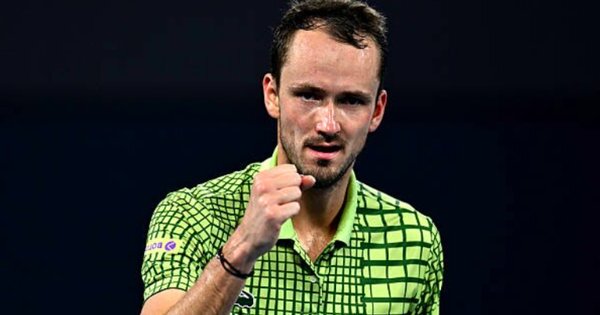
There are players you admire instantly, whose natural grace on a tennis court inspires immediate devotion. Daniil Medvedev is not one of those players. And that is precisely what makes him so compelling.
Born on February 11, 1996, in Moscow, the Russian has carved out a singular place in the scene of world tennis, not by following the sport's aesthetic conventions, but by dismantling them with rare tactical intelligence and a style nobody saw coming. At nearly twenty-nine years old, Medvedev represents a form of tennis resistance: a player who proved you could reach the summit without ever resembling anyone else.
To understand Medvedev, you first have to set aside your visual reference points. His forehand, struck with an extremely flat grip and an arm that appears to unfold like a mechanical lever, defies every coaching manual. His two-handed backhand, produced with a surprisingly low trajectory, looks like nothing else on tour. His court positioning, often several meters behind the baseline, gives him an ability to absorb opponents' strikes that drives them to distraction. He has often been described as a wall, but he is an intelligent wall, one capable of redirecting the ball with surgical precision and a variety of pace that few players command to such a degree.
Medvedev's path to the elite was anything but linear. Trained partly in France, in Cannes, where he spent several formative years at a tennis academy, he first had to contend with an atypical physique. Tall, lanky, with footwork that sometimes appeared approximate, he checked none of the boxes for the prototype of a future champion. Observers acknowledged his above-average intelligence, his ability to read an opponent's game, but many doubted whether that would be enough against the physical powerhouses who dominated the tour.
The summer of 2019 changed everything. Over the span of a few weeks, Medvedev strung together finals with staggering consistency, reaching six consecutive finals including three titles, culminating in that US Open final against Rafael Nadal that remains one of the defining matches of the decade. Down two sets to love, the Russian had turned the tide to force a fifth set of extraordinary intensity before falling in a conclusion that left him in tears but won over the New York crowd. That evening, Medvedev graduated from promising talent to legitimate contender for the sport's biggest prizes.
What makes his game so disorienting for opponents is the near-total absence of topspin in his groundstrokes. Where the majority of modern players use heavy rotation to add margin to their shots, Medvedev strikes flat, generating low, fast trajectories that skid through the court and barely bounce. This characteristic, combined with his height of six feet six inches, allows him to cover the court in a manner unlike anyone else, turning every rally into an exercise in patience for opponents who struggle to find angles to wrong-foot him.
His relationship with the drop shot deserves its own chapter in his legend. Medvedev loathes drop shots, both his own and those of his opponents. His deep court position makes him theoretically vulnerable to the tactic, and yet his anticipation and foot speed often allow him to neutralize opponents' attempts. As for his own drop shots, they are rare, occasionally clumsy, and frequently the subject of his own sardonic commentary in press conferences. This disarming honesty about his limitations is an integral part of the character.
And Medvedev is very much a character, in the most distinguished sense of the word. In a sport often constrained by convention and obligatory politeness, the Russian stands out through his candor, his deadpan humor, and his occasionally controversial outbursts. Who could forget his provocative gesture toward the US Open crowd in 2019, transforming their boos into a source of energy that propelled him all the way to the final? Or his press conferences where he wields self-deprecation with a skill that would make professional comedians envious? Medvedev does not play a part. He is authentically different, and that authenticity shines through in his game as much as in his words.
The absolute peak of his career remains, to this day, his victory at the 2021 US Open. Facing Novak Djokovic, who was chasing the calendar Grand Slam, Medvedev delivered a tactical masterclass of rare perfection, winning in straight sets with a command that left the Serbian powerless. That evening, the Russian proved he could not only compete with the very best but dominate them in the most pressurized moments. The weight of expectation fell entirely on Djokovic's shoulders, and Medvedev exploited it with remarkable composure, conceding not a single opening in a match that will stand as one of the most complete performances of his career.
But Medvedev's tennis story also speaks of missed appointments, particularly at the Australian Open, where his journey has been tinged with frustration of an almost literary quality. In 2022, he reached the final against Nadal under dramatic circumstances, leading two sets to love before watching the Spaniard produce one of the greatest comebacks in Grand Slam final history. The anguish of that defeat, written across Medvedev's face, was a reminder of how cruel tennis can be for those who approach glory without quite managing to seize it.
History repeated itself with almost poetic cruelty in January 2024, when Medvedev once again led two sets to love in the Australian Open final, this time against Jannik Sinner. The scenario, bearing an unsettling resemblance to 2022, saw him gradually unravel as the young Italian surged forward, eventually winning in five sets to claim his first Grand Slam title. Losing two Grand Slam finals from two sets up is a statistical burden that few players have ever had to carry, and the wound inevitably fed questions about Medvedev's ability to clear the final hurdle at those decisive moments.
The 2025 Australian Open brought a disappointment of a different nature entirely. Eliminated early by young American Learner Tien, Medvedev saw his Australian ambitions evaporate without even reaching the second week, a result that fueled questions about his form and motivation at the start of the season. At twenty-nine, the Russian finds himself at a crossroads in his career where every underperformance invites speculation about a potential decline.
Yet reducing Medvedev to his defeats would be profoundly unfair. His trophy cabinet, which holds more than twenty ATP titles including a Grand Slam and several Masters 1000 crowns, speaks to an exceptional career. His ability to adapt to different surfaces, though most comfortable on hard courts, his longevity at the highest level, and his influence on the modern game make him one of the most important players of his generation. He has been world number one, won the ATP Finals, and defeated each member of the Big Three on multiple occasions.
From a tactical standpoint, Medvedev has brought something genuinely new to tennis. His ability to slow the game down, to absorb an opponent's power and transform defensive positions into offensive opportunities, has inspired an entire generation of players and coaches. His serving, often underrated, is in reality one of the most effective weapons on tour, with an ability to vary placement and spin that compensates for a ball speed lower than that of the circuit's biggest servers.
Medvedev's future on tour remains an open question in this spring of 2025. The rise of Sinner and Alcaraz, the increasing depth of the circuit, and the physical demands of a full season represent considerable challenges for a player whose style relies more on intelligence than raw power. But if there is one lesson to draw from Medvedev's career, it is precisely that he should never be underestimated. The man who built his career by defying convention has certainly not finished surprising us.
will endure in the history of tennis as an anti-hero in the purest sense: a champion who refused to conform, who transformed his supposed weaknesses into formidable weapons, and who reminded the tennis world that the beauty of a sport does not reside solely in technical perfection but also in originality, intelligence, and the courage to be different. In a tour that sometimes trends toward uniformity, that singularity may be his greatest title of all.