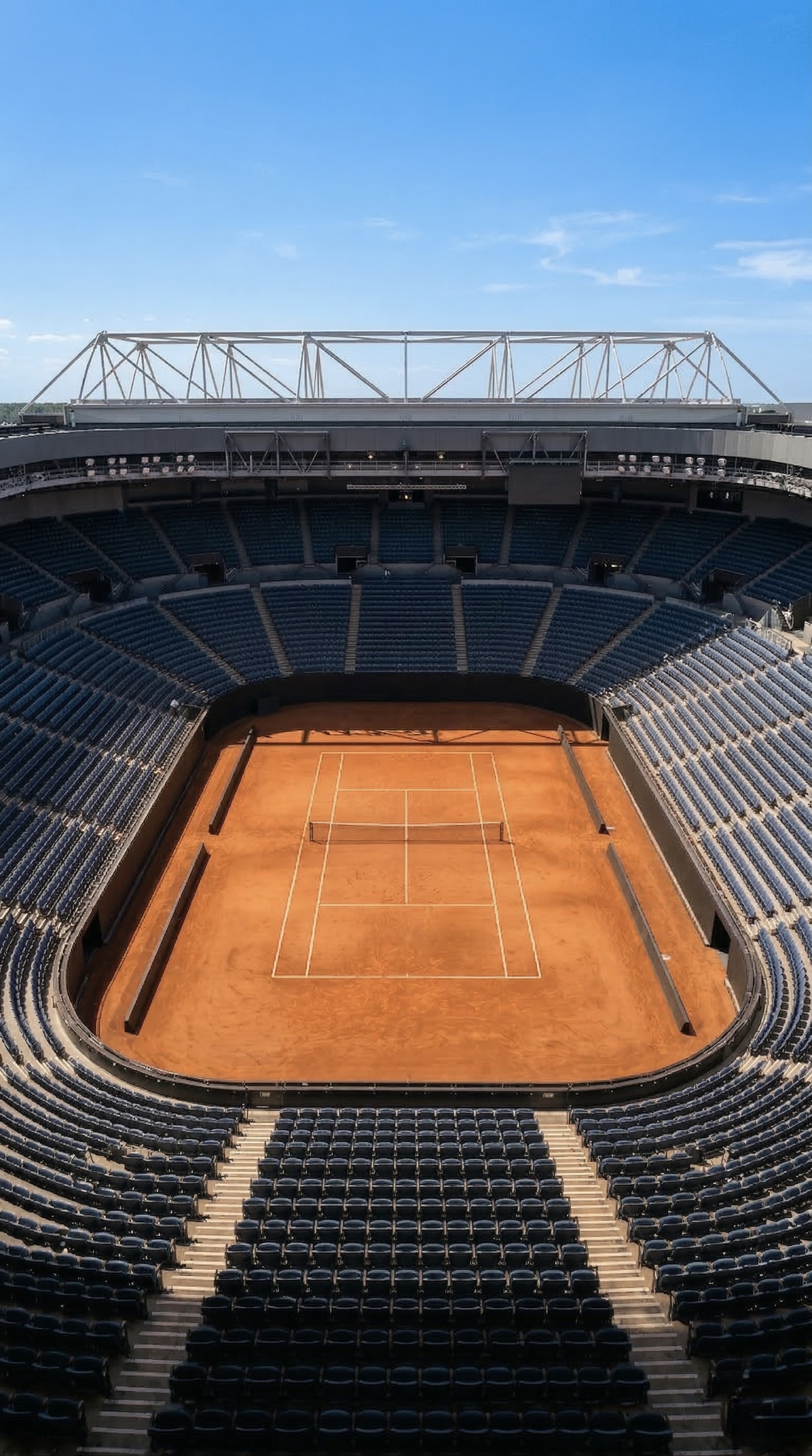
There is something about clay that strips tennis down to its rawest form. On hard courts, a big serve and a forehand can paper over tactical deficiencies. On grass, a few well-placed volleys can end points before they truly begin. But on clay, the red dirt slows everything down, bounces everything up, and forces players to prove, over and over again, that they belong. The 2025 clay season, now in full swing through Monte Carlo, Madrid, and Rome, has delivered exactly that kind of reckoning.
Any conversation about clay court tennis must begin with the absence that defines it. Rafael Nadal retired at the end of 2024, and the void he left is not just statistical but existential. Fourteen French Open titles. A winning percentage on clay that defied belief. A style of play so perfectly suited to the surface that it seemed as though the dirt itself had been designed for him. His topspin forehand, kicked up to shoulder height by the clay's generous bounce, turned baseline rallies into physical ordeals that broke opponents not just tactically but spiritually. In 2025, no one has replaced him. Perhaps no one can. But what has emerged instead is a fascinating power struggle among players who each claim a piece of what Nadal once held in totality.
Casper Ruud has the strongest case for the title of clay court king in the post-Nadal era. The Norwegian, a two-time Roland Garros finalist, built his career on this surface. His heavy topspin forehand, modeled in part on Nadal's own, is a weapon that gains potency with every extra millisecond that clay provides. Ruud's game is one of relentless pressure from the baseline. He moves his opponents side to side, opens up angles with patience rather than power, and waits for the right moment to pull the trigger on a down-the-line winner. What has changed in 2025 is his composure under pressure. In previous seasons, Ruud had a tendency to tighten in the biggest moments, to play not to lose rather than to win. This year, there has been a discernible shift. His body language on court exudes a quiet confidence, and his shot selection in critical points suggests a player who trusts himself in ways he did not before.
presents a more complicated picture. The Greek possesses perhaps the most aesthetically pleasing game on clay of anyone currently playing. His single-handed backhand, struck with a fluid, almost effortless motion, produces trajectories that are uniquely dangerous on this surface. The ball kicks up high and fast off the clay, pushing opponents back behind the baseline and opening up the court for Tsitsipas to move forward. His willingness to come to the net, to finish points with touch volleys and swinging volleys alike, gives his game a dimension that pure baseliners lack. But 2025 has been a year of inconsistency for Tsitsipas. His results have fluctuated, and there have been matches where his level has dropped alarmingly between sets. The talent is undeniable, but talent alone has never been enough on clay. The surface demands consistency, demands that you show up for every single point, and Tsitsipas has not always managed that this season.
might be the most exciting clay court player to watch in 2025. The Italian plays tennis the way jazz musicians play music: with improvisation, with flair, with an apparent disregard for convention that somehow produces moments of spectacular beauty. His single-handed backhand, his drop shots that die on contact with the clay, his ability to change the rhythm of a point with a single slice or a sudden acceleration — all of it makes him a nightmare to prepare for. What has matured in Musetti's game this season is his ability to compete when the artistry is not flowing. At Monte Carlo and Madrid, he showed that he can grind out wins on days when his touch is not quite there, winning through sheer determination and tactical intelligence. For a player once dismissed as a highlight reel without substance, this is significant progress.
brings a different energy to clay court tennis. The Dane is aggressive by nature, preferring to dictate play rather than engage in extended rallies. On clay, this approach requires exquisite timing and unwavering self-belief, because the surface naturally favors the defender. When Rune is on, his ability to take the ball early, to step inside the baseline and redirect with power, can overwhelm even the best clay courters. When he is off, the errors pile up and the clay seems to punish every miscalculation. The 2025 clay season has been a learning experience for Rune, a process of discovering how much aggression the surface will tolerate and how much patience it demands in return.
On the women's side, 's dominance on clay has reached a level that invites comparison with the greatest surface specialists in history. The Pole, a four-time French Open champion, plays clay court tennis with a ferocity and precision that leaves opponents searching for answers they rarely find. Her forehand, struck with tremendous racket head speed and heavy topspin, generates a bounce that most players simply cannot handle. It pushes them back, forces them to hit from above their shoulders, and turns neutral rallies into defensive emergencies. But Swiatek is far more than just a forehand. Her movement on clay is exceptional, her tactical awareness is sophisticated, and her mental resilience in tight moments has improved markedly over the past year. In 2025, she enters the clay season as the overwhelming favorite, and nothing that has happened so far suggests that assessment is wrong.
's relationship with clay has been one of the more intriguing storylines of recent seasons. The Belarusian's game, built around enormous power from both wings, was designed for hard courts. On clay, where the surface absorbs pace and gives defenders time to retrieve, that power can become a liability if not complemented by patience and variety. To her credit, Sabalenka has invested significant effort in adapting her game for clay. In 2025, the results of that work are visible. She has developed a more nuanced approach, incorporating drop shots, slices, and changes of pace that keep opponents guessing. She is not yet as comfortable on clay as she is on hard courts, but the gap is narrowing, and on her best days she is capable of beating anyone on any surface.
represents a different archetype of clay court competence. The American does not overpower opponents or dazzle with creativity. Instead, she competes with a quiet, methodical efficiency that is perfectly suited to the demands of clay. Her ball-striking is clean and consistent, her movement is excellent, and her ability to absorb pace and redirect it with accuracy makes her an exhausting opponent. On clay, where rallies are longer and every point is earned rather than gifted, Pegula's steadiness becomes a formidable weapon. She may not be the most talented player on the surface, but she is one of the most difficult to beat.
's emergence as a clay court force has been one of the most heartwarming stories in recent tennis. The Italian, standing just 163 centimeters tall, reached the French Open final in 2024, a result that announced her arrival at the highest level of the sport. On clay, her diminutive stature is less of a disadvantage than it might seem. She slides beautifully on the surface, covers the court with remarkable speed, and finds angles that taller players cannot. Her fighting spirit is extraordinary, and she has a knack for raising her level in the biggest moments. In 2025, buoyed by the confidence of her breakthrough season, Paolini has established herself as a consistent threat on clay, reaching the latter stages of tournaments with regularity.
What makes the 2025 clay season so compelling is the philosophical tension at its heart. Clay has traditionally rewarded a specific style of play: heavy topspin, patient construction, physical endurance, defensive excellence. The great clay court players of the past — Borg, Nadal, Kuerten — embodied these qualities. But the modern game is evolving, and a new generation of players is challenging the orthodoxy. They hit flatter, take the ball earlier, come to the net more frequently, and refuse to accept that clay demands a passive approach. The result is a fascinating clash of styles that plays out in every tournament, in every match, sometimes in every point.
The surface itself is an active participant in this drama. Clay's higher bounce and slower pace give defenders an extra fraction of a second to reach balls that would be winners on faster surfaces. The ability to slide on clay adds another dimension to movement, allowing players to reach wide balls and then recover their position in ways that are impossible on hard courts. But clay also rewards aggression when it is well-timed. A well-struck drop shot on clay, hitting the surface and dying with minimal bounce, is one of the most effective shots in tennis. A heavy topspin forehand that kicks up above shoulder height can be just as devastating as a flat winner on a faster surface.
The physical demands of clay court tennis are immense. Matches are longer, rallies are more grueling, and the sliding movement pattern places unique stresses on the body. Managing the physical toll of the clay season — which runs from April through June, encompassing Monte Carlo, Madrid, Rome, and Roland Garros — has become a critical strategic consideration. Players must balance competitive ambitions with physical preservation, choosing their schedules carefully to arrive at Roland Garros with enough energy and confidence to compete for the title.
As the 2025 clay season builds toward its climax at Roland Garros, the questions multiply. Can Ruud finally convert his clay court excellence into a Grand Slam title? Will Swiatek continue her reign, or will Sabalenka or Paolini find a way to dethrone her? Can Musetti translate his artistry into deep runs at the biggest events? The beauty of clay court tennis is that these questions will not be answered quickly or easily. They will be resolved over hours of grueling competition, through rallies that test the limits of physical and mental endurance, through moments of brilliance that emerge from the crucible of sustained effort. Clay demands everything. In 2025, the players who answer that demand are writing one of the most compelling chapters in the surface's storied history.