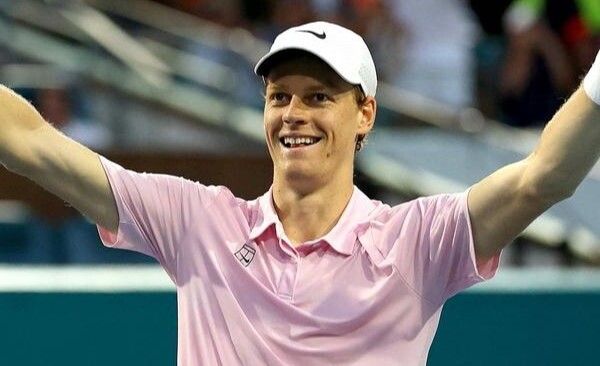
The scene was striking. After his 6-2, 6-4 quarterfinal victory over Andrey Rublev at the Italian Open, Jannik Sinner leaned against the interview zone wall, legs trembling, breath short. Interviewer Laura Robson cut the conversation short: "You're leaning against the wall, it looks like the legs are tired, so I'll let you go."
Those images reveal something statistics don't always capture. Over three months, the world No. 1 has accumulated 27 wins in 68 days, roughly one victory every two and a half days. A relentless pace that has carried him to a historic record of 32 consecutive Masters 1000 wins, surpassing Novak Djokovic's 31 set in 2021.
Sinner's paradox lies in this duality. On court, the machine runs at full capacity. Against Rublev, he wrapped things up in two sets without ever appearing in danger, extending a streak of 20 consecutive sets won dating back to Madrid. But the moment the final point is played, the mask slips. The 23-year-old briefly doubled over, clutching his legs and struggling to keep his balance.
His Rome campaign remains impressive: four matches, no sets dropped. Five consecutive Masters 1000 titles. A level of dominance with no parallel in contemporary tennis. Yet the question looms ever larger: at what cost?
Friday evening's semifinal against Daniil Medvedev presents a test of an entirely different caliber. The Russian, who came back from a set down to defeat Martín Landaluce, will bring far greater physical and mental resistance than any of Sinner's previous opponents this week.
For the Italian, the stakes extend beyond a single result. Roland-Garros begins in nine days. Finding the balance between chasing records and preserving his body will be the true challenge of this clay-court stretch.